
I shall attempt something a little hazardous and, I warn you, in a manner that is somewhat arbitrary.[1] I shall attempt an entirely political reading of certain theoretical categories originating in the 1930s, but whose subsequent history runs to our present moment. I shall begin with the definition of the concept of ‘organised capitalism’. Properly speaking, one should trace it back to the 1920s, to the debate between Rudolf Hilferding and Otto Leichter on organisierter or politisierter Kapitalismus, or to the discussion between Otto Bauer and Hans Kelsen on the Zukunftsstaat. I shall select instead a more contemporary approach that enables us more briskly to arrive at the core of the issue. In Legitimationsprobleme im Spätkapitalismus (1973), Habermas writes: ‘The expression “organized or state-regulated capitalism” refers to two classes of phenomena, both of which can be attributed to the advanced stage of the accumulation process. It refers, on the one hand, to the process of economic concentration … [and on] the other hand, it refers to the fact that the state intervenes in the market’.[2]
What is the basis for such a definition? We can discover it in another contemporary text, extremely present in contemporary debates, James O’Connor’s The Fiscal Crisis of the State (1974). There he speak of a ‘three sector’ model: the industries organised by capital on the one hand, and those organised by the State on the other. The private sector, i.e., production and distribution tied to the private sector is divided into two sectors: competitive industries organised by small capital, and monopoly industries organised by large-scale capital. Therefore, the three sectors are: competitive sector, monopoly sector, and State sector. O’Connor outlines the genesis of this three-sector model in the following terms. In the precapitalist era ‘public property was a particular form of private property in the hands of dominant groups’.[3] The feudal State’s budget deficit includes an undifferentiated mixture of private and public expenditure. With the development of mercantile and industrial capitalism, public property comes increasingly under public control and private property establishes itself as an autonomous institution. The limitation of current expenditure and the balance of payments served to prevent the State from assuming the preceding control over the economy. With the end of liberal capitalism, radical changes intervene deepening the interweaving of State capitalism and monopoly capitalism. The characteristics of this phase are: direct taxation, the abandonment of the balanced budget, the new role of debt financing, the increase in State expenditure, the expansion of the economic functions of the State, and the centrality of the system of administration by a permanent State bureaucracy.
It is telling that Habermas in turn provides a genetic account of the contemporary nature of organised capitalism that more or less repeats this formulation. Habermas writes: ‘While the political form of the relations of production in traditional [precapitalist][4] societies permitted easy identification of ruling groups, in liberal capitalism manifest domination was replaced by the politically anonymous power of private subjects[5] …. But, while in organized capitalism the relations of production are indeed repoliticized to a certain extent, the political form of the class relationship is not restored.’[6] A ‘quasi political wage structure’[7] assumes the role of historical precursor, no longer depending on the competitive pricing within oligopolistic markets, but by the negotiations between companies and unions. Therefore, in the two central sectors, that of monopoly and that of the State, and in the respective industrial branches, ‘labour power receives a “political price”’.
I have returned to Habermas and O’Connor so as to situate the discussion on the cases of Germany and the United States, which will remain the leitmotif of my framing of the issue. We can observe that while the results of the two positions are different, the logic of the argument is more or less the same. In the case of O’Connor, we find closer attention being paid to the State-capital relation, whereas in that of Habermas we see a greater focus on the conditions of a new class struggle. What is there in common between these two positions? To my mind the commonality lies in a dialectical history of the problem specifically in relation to the private property/public property relation, understood as the relationship between production and politics. What is the dialectical history of the problem? That there is a pre-capitalist phase, a phase that corresponds to liberal capitalism, and one that corresponds to organised capitalism. Here we find a first error that one must criticise and dismantle. In reality, the passage between these three phases should be fully integrated into the history of capital or capitalism. In practice, these three passages should correspond to the transition to capitalism, the phase of capitalist development, and the phase of capitalist crisis. With an argument of this sort, we are not far from a discussion of the capitalism of the 1930s, for if it is true to say that what issues from this period is a form of State-regulated capitalism, and it does so through the Great Crisis,[8] this was made possible insofar as that relationship was already implicit in the capital relation itself, which is to say, in the form of capital itself. The private property/public property relation, the relation of production to the political is part of the nature of capital itself from its very beginnings and is not a late consequence of its history. I would argue that, on the basis of this argument, one should take the opportunity to free oneself of what, to my mind, is the cumbersome image of liberal-competitive capitalism as the ideal or eternal form of capitalism. One should instead underline the fact that this is a phase in the history of capitalism, both central and important of capitalism’s history: a piece of history and a particular phase that, however, produced a totalising ideology. Liberal capitalism has tended to reduce all of capitalism to itself. And, so, it is not by chance that this phase has produced the highest point of bourgeois ideology, when it was possible to reconnect liberal-competitive capitalism to the political theories of liberalism first, and liberal-democracy later.
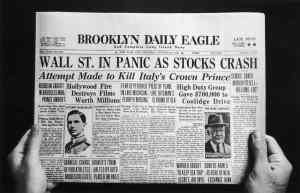
Here, in the way that a period of the history of capital was able to produce an ideology valid for the entirety of its history, there is a process that perhaps we have yet to understand: the process of capitalist production of ideology. It is a particular terrain of analysis that one should perhaps give greater consideration to than it has received to this point. Marxism, and Marx’s own work, failed to enter the laboratory of the relations of production of this specific product that is ideology. Instead, they analysed the circulation of bourgeois ideologies, the paradoxical consequence of this ideological division of labour is that freedom, security, rights were left in the hands of capitalism, whereas the moment of coercion, the moment of direction, of power, the State, passed to the existing workers’ movement. We should explode this schema and perhaps the occasion for it is provided by the specific topic of discussion closest to us today. There is a relationship between capitalist social production – its foundation, its management, its crisis – and the political function of the State. It is a very tight relation, extremely organic and entirely necessary. The problem explodes around the theme of capitalism’s origins, on that of the transition to capitalism, where we see this nexus between political State function and the foundation of capitalist production as a very tight one and absolutely impossible to divide into two parts. When one attributes the apologia for the State and its power to certain solutions provided by the workers’ movement, we often do not respond by recalling the fact that this apologia of the State has a typically bourgeois origin. Hobbes was not a functionary of the Third International. Leviathan is not one of Stalin’s posthumous works.
Let us just take one example and then we shall leap ahead as this problem is not central to our discussion here. Take the discussion that had actually also taken place in the 1930s, on the definition of mercantilism. The first volume of E. F. Heckscher’s great work Mercantilism, was published in 1931. It is Keynes who, drawing precisely on this work, brought attention upon what of value the classical political economists had overlooked in their predecessors. As ‘a contribution to statecraft’, wrote Keynes, the ‘fragments of political wisdom’ of economic thinking of the sixteenth and seventeenth centuries have counted for more than the unrealistic abstractions of Ricardo’.[9] Which is to say, from the transition there is a form of classical bourgeois thought that emphasises political State form as a founding element of capitalist social organisation.
The 1930s were decisive in taking up this theme again. But one should not extract from this other part of the history of capital (and this note of caution should correct the discussion we have pursued so far) an inverted bourgeois ideology and so introduce into the contemporary debate an image of capitalism as a Moloch slaughtering human rights. This would be to take up a futile political romanticism that is also to be found in current political debates.
In truth, we claim that mature capitalism – and here we approach our theme – issues from the Great Crisis. That is to say, a process of capitalist accumulation with different historical characteristics emerges. This thread of the production-politics relation tying the history of capitalism from the transition to the Great Crisis, should not lead one to think that we are proposing a continuity thesis. On the contrary, for ease of exposition, rather than due to instinctive preference, I would tend to underline the moment of rupture of this passage to the Great Crisis. It is increasingly productive to underline these violent transitions, these leaps that shift the perspectives of practice, that modify the form of theory and commit us to having to find new solutions.
However, when we call mature capitalism that which issues from the Great Crisis, we must reflect further. The notion of the maturity of capitalism has today acquired a somewhat different meaning than was typical of those years and those that followed, perhaps until the end of the 1940s. There is an equation made between two real terms that has over time been lost and that it would be well to recover and update. Those terms are those of maturity and of stagnation. It is precisely in the 1930s that the concept of mature capitalism is linked with the theories that go by the name of the ‘decline in investment opportunities’, with the process of the weakening of the opportunity for private investment, which is to say, with the crisis of a historical tendency to spontaneous private capital accumulation. Alvin H. Hansen speaks of the stagnation of the United States’ economy, with its conspicuous long-term mass unemployment, precisely on the basis of the state of long and persistent depression in which the United States found itself in the decade between 1930 and 1939. Frank G. Steindl will interpret this not as a contingent occurrence but as the result of underlying modifications in the functioning of the economic system beginning many years earlier (he goes as far as to say: ‘we could go back to the American civil war’[10]) and by reason of their lengthy gestation destined to live on in time. Not by chance Steindl speaks of two types of industry, competitive and monopolistic, as two ideal types, in the Weberian sense, inasmuch as they cannot be found in their pure form in reality, but always only as approximations. And he writes: ‘The most important conclusion that arises from our distinction is that the expansion of monopoly industries to the detriment of the other type can lead to a radical change in the functioning of the economic system, with the consequence of a greater inelasticity of profit margins or even the tendency for their increase, destroying the mechanism of the elimination of excess capital and resulting, therefore, in the tendency to reduce the degree of utilisation and the dampening of investment’.[11] After the long term trend[12] that runs, broadly speaking, from 1869 to 1929 that is of positive capital accumulation, albeit alongside normal crises of cyclical adjustments, from 1929 there begins a series of cycles (the most dramatic being 1929-33, while 1938-9 will repeat some elements of the earlier cycle) that open the phase of the Great Depression, where net investment is unable to produce full employment.

This is the fundamental characteristic of post-Great Crisis mature capitalism. Keynes sets out from the body of this analysis. Despite the underestimation of the moment of crisis to be found in parts of Keynes’ work, which include elements of theoretical optimism that appear here and there, the hard and dry substance of radical knowledge that ultimately subtends Keynes’ account is at heart pessimistic on the situation of capitalism. I refer, for instance, to the 1931 text of the round table at the University of Chicago’s Harris Foundation on the theme of ‘Unemployment as World Problem’, where with Hansen as interlocuter, Keynes states: ‘Capitalist society as it functions today is essentially unstable. What I ask myself is whether we will be able to maintain stability with the introduction of a moderate level if control […] and if that of which we have need is not a higher control plan’.[13] These are Keynes’ words, and it is no coincidence if in Chapter 23 of The General Theory we come across the following words, specifically in relation to his interpretation of mercantilism: ‘Thus, the weight of my criticism is directed against the inadequacy of the theoretical foundations of the laissez-faire doctrine upon which I was brought up and which for many years I taught;— against the notion that the rate of interest and the volume of investment are self-adjusting at the optimum level, so that preoccupation with the balance of trade is a waste of time. For we, the faculty of economists, prove to have been guilty of presumptuous error in treating as a puerile obsession what for centuries has been a prime object of practical statecraft.’ We are closing in on the State-response to this veritable turning point in the history of capitalism. But first there is a logico-historical transition which we can find summarised effectively in a statement of Michal Kalecki’s (which Marramao recalled earlier),[14] but that I would like to give in full because I believe it to be extremely significant. Kalecki composed it 1943, after the escape from the Great Crisis via policies of public expenditure: first with the objective of full employment, then with the objective – less troubling from the capitalist standpoint – of maximum military power. Kalecki writes: ‘This pattern of a “political business cycle” is not entirely conjectural; something very much like that happened in the USA in 1937-1938.’[15] The concept of political cycle is itself a product of the 1930s.
At that same round table, it was objected to Keynes that: ‘You have said that you would be happy to see firstly a resort to moderate control by modern management, and were this to fail, resort to something more radical.’[16] Indeed, Keynes had said: ‘I would begin by trying with the central bank system, despite being uncertain how far this would take us. Where the central bank system proves itself incapable of maintain a reasonable level of stability, then I would have recourse to a much higher degree of State control over the rate of investment.’[17] Keynes’ reply to the objection is summarised in a single sentence: ‘A painful experience produces miracles’.[18] But let us return to Kalecki’s ‘Political Aspects of Full Employment’, which details these painful experiences that are compelled to produce miracles. In relation to the crisis of 1937-8 and to the fact that then, for the first time, a political cycle in the specific sense of the term is organised, Kalecki speaks of: ‘the reluctance of the “captains of industry” to accept Government intervention in the matter of employment’.[19] Capitalist opposition to the creation of occupation by means of public expenditure emerges directly within the crisis. The reasons for such opposition are political: 1) dislike for public interference as such; 2) aversion to the specific orientation of public expenditure (public investments insofar as they introduce the State into new spheres of economic activity; subsides for mass consumption insofar as they a contrary to the capitalist-Weberian-Schumpeterian ethic of the entrepreneurial Beruf); and 3) distaste for social and political changes resulting from the maintenance of full employment, insofar as this becomes a factor of imbalance, because it puts in question the levels of capitalist power and of working class organisation. And we know, says Kalecki, that ‘“discipline in the factories” and “political stability”’[20]are preferred to the profits by industrial leaders. Indeed, just to allude to another theme of our discussion: ‘One of the important functions of fascism, as typified by the Nazi system, was to remove the capitalist objections to full employment.’[21] But I suggest that it is not to this issue that we should turn to seek the model of political cycle, but to that which is its real terrain, capitalist democracy. Only in this way may the comparison of the two most successful examples [esperienze] of the 1930s – Germany and the United States – result in potential discoveries. The miracle that Keynes hoped would come about begins to delineate itself here, in the presence of the State response to the Great Crisis. What crystalises here is a political block of social forces with large-scale industry, the monopoly sector, at its centre, which will induce the government to return to an orthodox politics with a drastic reduction of budgetary deficits. It is what takes place prior to 1937 and that in turn provokes an abrupt end to the expansion that had taken place between 1933 and 1937. In the profound depression that followed, the government returned promptly to a policy of expenditure. Now the principal objective was not full occupation but – as we dimply alluded to – maximum military expenditure. One takes the path to war and to the real escape from the Great Crisis.

We shall attempt to recompose and reflect upon the pieces of this mosaic. Let us start by underlining an extremely important point: with the State’s handling of the crisis, which is to say, with the rise of the political cycle, a third front of struggle opens up in addition to that which saw capital and workers on one hand, and workers and the State on the other. These two historic terrains, the economic and the political, had been retranslated by the development of Marxism and, specifically, by the Leninist practice on the plane of economic struggle and on that of political struggle. The third front is that between capital and the State, between the monopoly sector from the economic standpoint and the central State sector from the political standpoint. I believe that a large part of the difficulties that the communist movement encountered that goes under the heading ‘the revolution in the West’ derive from the historic delay with which it began to consider this critical relationship of capital-State as the opening of a new natural terrain of the class struggle: not as an internal affair of capitalism, but rather as a real opportunity for the workers’ movement. It was necessary to intervene immediately and actively within this relationship, with a new strategic deployment [dislocazione] of forces, with new forms of organisation, new analytical dimensions of theory that had to start by producing a veritable revolution in the way of thinking and practicing politics. Much of the bitterness, the sectarianism, and the one-sided approaches that have arisen in political discourse here in recent years, derive from this acute heartfelt necessity and urgency to leap quickly over this delay and to accelerate through the steps required to regain a theoretical grasp of the Gesamtprozess [overall process] of contemporary capitalism.
Summarising somewhat bluntly: at the international level, organised capitalism has advanced in the absence of the organised workers’ movement – organised in our sense, i.e., that of the communist tradition, that of the Leninist solution to the problem of organisation, i.e., of political class and mass organisation. Find elsewhere the fragments of organisation on the terrain of the new capital-State relation. For example, in the American struggles of the 1930s and their rich, ambiguous relationship that still needs deciphering, with specific levels of organisation that are not immediately political but trade union-political, and in the encounter-clash with a powerful State-led initiative. I speak of the tight and direct nexus that is established in the America of the ‘30s between workers’ struggles on one side and the Congress of Industrial Organisations (CIO) and New Deal on the other. This is a large experience of class struggle that is not read from a Marxist standpoint. The other fragments of organisation are the classic social democratic governing experiences, which we begin to understand a little better and closer at hand, and that in some way take cognisance of this new critical relationship that is established between State and capital and that seek an answer. But as soon as we name these experiences of organisation, we immediately take the measure of the distance that separates us from them. Why? Because the specific type of American working-class struggle, of workers’ struggles without the political, end up functioning as nothing more than mass pressure on individual capitalists by the State. The CIO, for instance, operates materially in the United States of the 1930s as an instrument to escape the Great Crisis, which with its actual organisation of large-scale struggles ends up as the subordinate part of the great State-directed operation over the workers’ movement. In this way, once interpreted, the social democratic experience of government ends up being nothing other than the pure mediation between the two terms of capital and power, a subordinate composition of the contradiction; and, so, the social democratic organisation of the masses is unable to produce anything but a political grouping [ceto] connecting the three sectors of mature capitalism. From these segments of history one can derive the necessity of an articulated social block whose project it is to govern capitalist crisis and that has, at the same time, the strength to put it into effect in autonomy from the crisis itself.
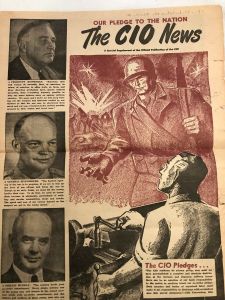
It follows that in the capitalism of the 1930s we find a complex knot that the workers’ movement has been unable to undo either theoretically or organisationally. This knot is made up of various nodes: maturity and stagnation, crisis and State. Between these nodes explode long term historical processes that end up modifying the very terrain of the class struggle, when compared to the immediate precedents, to the 1920s and those that following the Bolshevik October seemed to be the age of proletarian revolutions. The long-term processes, born in the 1930s, are principally two: the stabilization of capitalist power and re-politicisation of the relations of production, to take-up again Habermas’ definition. Two processes that spontaneously tend to diverge and that therefore demand an excess of social control, a surplus of political leadership, and an increased concentration of decision-making. It is here that I see a hypothesis verified, where two large-scale realities meet: decision-maker State on the one side, organised capitalism on the other. Two parallel realities that echo one another, that correspond but that are not produced – in the sense that neither one produces the other. I agree that it is not a case of emphasising this theme or this term of the primacy of power but one must rather go in and see how a series of reciprocal autonomies between parts of society are actualised. Previously, there had been a history of the State. Both in Germany and in the United States. Bismark or Theodore Roosevelt, whose names stand-in for large-scale processes, were not simply the product of monopoly capitalism, but had been founding causes, indispensable articulations on the path to this phase of capitalist victory. And there had been a history of capitalist production and the organisation of capitalism proceeding from the logic of the inner life of capitalism. This is the other point. Organised capitalism is not an entirely State creation. There was no political decision: from tomorrow capitalism will be organised! The organisation of capitalism, capitalism itself bears within it as an element of its nature, i.e., capitalist organisation is not brought from without, from the State; it is precisely a determinate type of capitalist development, one within which this type of division of tasks compared to the political, and within the political with the reality of the State. Two logics, then, for two different histories that should be read with different analytical lenses, on the basis of potentially unifying hypotheses grounded in a powerful grasp of the entirety, albeit fragmented, of large-scale processes.
There is a difficulty in advancing to a conclusion of our argument. The difficulty lies in the way that, today, the logic of the political sciences or social sciences develops. We live in a decidedly plural time: there are powers, there are knowledges, we’ve recently learnt that there are Marxisms too! We must understand that this plurality is the offspring of the age of decision. This has had totalitarian forms, democratic forms, and even socialist forms. Firmly holding together this formal unity without losing specific differences is, I believe, the task of a new political science and of a new critique, in the Marxist sense, of politics. The 1930s are, in their different political forms, an age of decision: an age of great politics, of politics as State. It is easy to read this politics-as-State in Germany and Nazi Germany, for example. The effort is rather to rediscover the democratic or social democratic anticipations of this political turn, of this becoming-State of politics, precisely in Weimar and not only in the crisis of Weimar but in its entire trajectory. In both camps: in the camp of capitalist consciousness and the camp of the workers’ movement. Here too, in abbreviated form, two names summarise the highest awareness of this problem. One is Walter Rathenau: a man, ‘larger than life’ [grande formato], as point of confluence of great processes. These great processes are those that he describes and recognises: the end of the economy as a private affair, i.e., the crisis of classical economic individualism; organised industry, i.e., production as organism, in his definition; the science of industry, and science of industry which combines thinking intellect and will-to-lead. It is Rathenau who writes that ‘diffidence towards the State […] is diffidence that is injurious to us’.[22] The other name who belongs more to the workers’ movement but has been cut from its consciousness as the name Carl Schmitt has been repressed from bourgeois theoretical consciousness, is that of Karl Renner. The point of contact between Max Weber and Hans Kelsen, his is the attempt to bend the State into a veritable subject of Sozialisierung [socialisation], which has as its presupposition in the automatism of capital and as an end or instrument, as a means, the working class. It is the highest point of the autonomy of the political of the State.
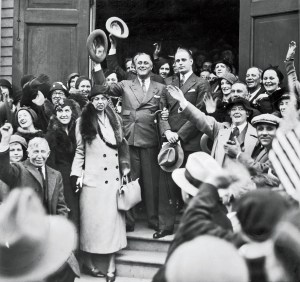
As I was saying, it is easy to recognise this becoming-State of the political in post-Great Crash Germany, i.e., in Nazi Germany. It is harder to see State decisionism and the political-as-State in democracies, and in particular in the United States. However, this is the element that we find ourselves today needing to decipher. It is the difficult point to account for, a theme I summarise under the heading of ‘decisionism and democracy’. We have said that the true exit from the Great Crisis was ultimately war, but not in the traditional sense that one gives to this statement, in the economic sense that the public sphere’s rearmament or military industries provide a natural path of development; but, rather, in the political sense: through war is eliminated the alternative totalitarian path of decisionism, which according to the Nazi model entailed a rigid control from above of monetary income, of prices, investments, of labour supply, and job creation, as one used to say in that period. With the suppression of the totalitarian alternative, capitalist democracy is forced to rediscover within itself, within its flexible mechanisms, the solution to that problem that is precisely that of the government of socialisation, which is the same problem the goes by the name of the organisation of capitalism. This is a current problem, that is born there and then. The problem is how, through which forms, can the great classes and then gradually social forces that become independent of the great classes – here is another process that we have experienced since the 1930s, a series of social forces that win independence from the great classes – do these classes express their own interests. Amending the definition somewhat: what is the political terrain that permits at one and the same time the struggle between these social forces and the resistance of the system? It is the problem of really existing democracy. How can class struggle, particularly the new forms of class struggle, be guaranteed without tearing capitalist society apart? This is the great problem of contemporary bourgeois politics. How can one guarantee class struggle, because class struggle still needs to be assured within capitalist society, whether it be mature or not, but how can one do so without the decomposition of capitalist society? It is the contemporary political problem. Here the answer is that the political becomes-State without abandoning the terrain of democracy: the State – said Schmitt – that wins the monopoly of politics, but here is the novelty: with Roosevelt and so without absolute power, which is to say, within a tradition and organisation that is that of American democracy. The figure of this solution has a classical stamp. For me, to speak of the Welfare State – I am now drawing on our current terminology – is to belittle this solution. The Welfare State is the system of democratic power, which is the local solution we find ourselves faced with. And we cannot look at world processes of the contemporary political with the eyes of the Dorotei.[23] The definition of the Welfare State fails to capture the complexity of the State solution that issues from the 1930s. I prefer to speak of the Social State and, with all the risks that such an expression bears with it, of State capitalism.[24]
Here there is a leap forward in political theory, of the same importance perhaps as that of John Locke, who develops his model on the basis of the English civil war and gives the grounds for a solution to the problem of the State, which is the winning one, precisely because it issues from a profoundly real experience, correctly reading this experience, interpreting it, resolving it, and becoming the solution internationally. The solution to the Social State exists in practice and it is without a Locke. It is true that there have been attempts to develop it, however, what has been missing – and this is one of the numerous difficulties we find ourselves in – is a Treatise on Government that provides a definition of the Social State. Moreover, it is pointless to express nostalgia for these beautiful theories, there will be no more, neither on their behalf nor ours. Besides, what would have been the point in the great crisis of the sciences, of the culture of crisis, had we found ourselves confronted by these beautiful systematic definitions of a developing political reality. Everything is to be found in practice; everything is to be read in things, in processes, within choices and decisions. Which does not mean that this new function of the State does not ask us, in a new form, a newly modern form, to think the political. But I won’t press the point, because I want to move on.
There is this fact: there advances a final process of freeing the State from the direct representation of capitalist interest arises. The process of the autonomisation of the political no longer has the material basis that Marx had seen, the provisional equilibrium between classes. Marramao has elsewhere recalled our attention to Otto Bauer’s theory, that of the democratic State, exemplified in the Democratic Republic of 1919-22, as one of class equilibrium.[25] This material basis is no longer sufficient to define the present-day form of the political that confronts us. The material basis of the process today, that of a particular grip of the autonomy of the political – if we still want to give it that name, but many other names will do – is the need to save capitalism, the necessity to escape the Great Crisis and, I would add, this is the fundamental point, the necessity of using the power of the working class to escape this crisis. Capitalism has realised this power, and it has done so precisely within the solutions put into practice in the 1930s. Behind it lay the success of the October Revolution, the Mitteleuropean attempts at revolution, and the class struggles in America. It was not a case of the integration of the values of the ruling class, either then or today, but of something much more complex. It is the participation of the working class within the management of the social. It was a case of beginning to use the very force of the working class in the management of the crisis of socialisation. Capitalist interest alone was unable to attain this. Capitalist interest could not demand, could never directly ask the organised workers’ movement to participate in the management of the social in crisis. Only the ideological assumption of a general interest could attempt such an operation of involvement of the workers’ movement in the management of the new social. Here is the space of manoeuvre that opens to political action.

And so social democratic government before and after the Great Crisis has different meanings. Here too there is a caesura, without continuity. It is necessary to realise that after that period every space that opens up to the workers’ movement at the political level and at the level of the State, every space that opens on that terrain is tied to the presence of crisis. We experienced this recently. We must coldly take note, without, as often occurs, confusing our rival’s necessity for the success of our own politics. The government of capitalist crisis includes a political manoeuvring of the workers’ movement as a whole, which is to say, struggle plus organisation. It is not possible to pass through a capitalist crisis, from the Great Crisis onwards, without capital attempting a political manoeuvre in relation to the workers’ movement through the State form. This fact must not create a block in the initiative of the alternative, it must not provoke a return flight into the autonomy of the social. The reality of this capitalist necessity of a political confrontation with the workers’ movement provides us with a high degree of opportunity. Why? Because it permits a qualitative leap in worker politics and organisation, because it tasks it with grappling with a more advanced terrain than available hereto to the class struggle. So it is. Without today setting out from a politics of government of capitalist crisis no practical project of escape from the system is available. There is no possible construction of a really functioning project of overcoming capitalism without passing through the government, perhaps in first person, of capitalist crisis itself. The extremist’s proposal that has greatest intellectual weight and counts the most, to the point that we found ourselves surrounded by it on many sides – handing politics to power, leaving the monopoly of politics to the State – such a proposal expresses the traditional logic of a subordinate [subalterna] class. For this reason, it must be defeated. The problem is instead that of using the spaces of movement that capital’s political must open up. Occupying these spaces, manoeuvring within them, leading social interests and a new project for a political system to bear upon them there – this appears to be today’s world political moment of the class struggle. The trial of strength will be between the one who has the greater strategy and tactics to expend in politics.
Within the political and upon the political we too perhaps need to construct a three-sector model. There is movement-politics and institutions-politics. Within institutions-politics we have the level of the State and the level of the party, which should always be clearly distinguished. Hence a new central thematic must be introduced: that of the articulations of the political. Which should not be confused with the themes of the dissemination of power and of the presumed death of the unity of power. The reality to be imposed is that power too, as is already true of society, is an articulation of the political. If it is true that from the capitalist side the problem is that of how to allow the new class struggle to function without disintegrating society and the State-form, our problem is precisely the opposite: how to hold together this society as we change it, how does one decide, who decides, what is decided in the diffusion and the socialisation of politics.
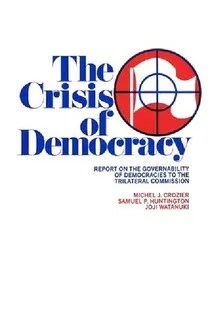
The relation between decisionist State and organised capitalism is experiencing a process of crisis. There is already a history of this crisis that runs from the 1960s, not till the end of the 1960s but till today. To speak in this case too ‘crisis of the Welfare State’ seems insufficient to me, for the same reasons previously given for why the definition of the Welfare State is insufficient. It would be to speak simply of a crisis of a system of power and, hence, of a crisis that turns only on our class adversary’s difficulties. It would be to extricate oneself from the crisis. Instead, we should courageously adopt the field [ambito] of the discourse that issues from ‘Trilateral’ great capital in the present period, that is played out in terms of the topic of crisis of democracy. The crisis of democracy involves the workers’ movement itself, and it is right in these times to feel oneself implicated in a crisis rather than stand outside it and look on. At the heart of this crisis of democracy we find the institution of government and the great contradiction that exists today between the expansion of its activities and the decline of its authority. We find ourselves within this fork [forbice]. The further material, quantitative activity of government, i.e., the level of decision-making, extends, all the more does this level of decision-making appear to lose its authority. The workers’ movement cannot serve to recharge the empty battery of State authority. The anti-authoritarian demands that stemm from the 1960s are now a historical inheritance of the workers’ movement, even if they have been brought to the workers’ movement from outside. One cannot do without this anti-authoritarianism. It is a case of putting it into play not in an old frontal war, from outside of the political, but more effectively within the body of its articulation
New relations between the centres of the workers’ movement – parties, trade unions, general organisations – and peripheral, not only social, movements but also immediately political ones: peripheral movements that are not secondary and are certainly not subordinate ones. The true legitimation for the management of a level of government comes about when a large part of the social is related to a politics of worker centrality. A real possibility is triggered there, one of a new level further capable of changing the balance of forces. Pluralism will be more real and will be all the less ideological the more it is able to produce a new unity of power. The history of capital has shown itself to have failed in the search for a real unity of power: precisely with its response to the Great Crisis of the 1930s. The history of capitalism no longer has solutions for this problem. Neither can solutions to this problem be found in the history of the State considered in its inner logic, it its specific independence from the history of capital. The history of the State too has failed the test: precisely with the great transformation that nevertheless took place in the 1960s. Social democracies and real socialisms both find themselves within the logic of these twin failures. The task falls to the communist movement in the West: this experience grows under the sign of a search for new solutions, far beyond all the historic traditions, with a minimum indispensable of theory, with a surplus of practice, and within politics.
[1] ‘Lo Stato del capitalismo organizzato’ was a lecture delivered at a two-day conference on the State and capitalism in the 1930s at the Gramsci Institute in Rome in November 1979. All notes as by the translator.
[2] J. Habermas. Legitimation Crisis, translated by T. McCarthy, Beacon Press: Boston 1975, p. 33.
[3] J. O’Connor, The Fiscal Crisis of the State, my translation from the Italian.
[4] Tronti’s addition.
[5] The English translation speaks of ‘civil subjects’. I have retained the Italian translation.
[6] Habermas, p. 37.
[7] Habermas, p. 38.
[8] The Italian expression of grande crisi, while used frequently for what in English is referred to the Great Crash, is often used as a synecdoche not only for the 1929 Crash, but also for the long cycle of crises, including the Great Depression of the 1930s, that followed. For this reason, I use the expression the Great Crisis, capitalised, that we should understand the Great Crash and all the ensuing cycles of crisis.
[9] J. M. Keynes, The General Theory of Employment, Interest, and Money, Palgrave MacMillan: Cambridge 2018, Ch. 23, §2, p. 303.
[10] I have translated this from the Italian. As Tronti’s is a lecture, references are missing. I have inserted those that I have been able to trace.
[11] My translation from the Italian.
[12] In English in the original.
[13] My translation from the Italian, as I’ve been unable to trace the quotations from this volume to the proceedings from the round table lectures: Unemployment as World Problem, edited by P. Q. Wright, Freeport New York, 1931. Keynes’ contribution was ‘An Economic of Analysis of Unemployment’, pp. 1-42.
[14] Tronti is referring to an earlier lecture at the same conference by Giacomo Marramao, translated with the title of ‘Corporate Pluralism, Mass Democracy and Authoritarian State’, in The Bewitched World of Capital, edited and translated by M. Mandarini, Brill: Keiden/Boston 2023, pp. 215-32.
[15] M. Kalecki, ‘Political Aspects of Full Employment’, The Political Quarterly 1943, 14.4, p. 330. It should be noted that Tronti speaks of ‘political cycle’ rather than a ‘political business cycle’. It is unclear whether this is due to the Italian translation of the Kalecki or whether this is a choice of Tronti’s, although I suspect that the change is not a mere abbreviation but a conceptual shift that is not fully theorised other than implicitly in the rest of the lecture.
[16] My translation from the Italian.
[17] My translation from the Italian.
[18] My translation from the Italian.
[19] Kalecki, p. 325.
[20] Kalecki, p. 326.
[21] Ibid.
[22] No citation provided.
[23] The dorotei were the mainstream, moderate current of Italian Christian Democracy.
[24] For a parallel and opposed view of these processes, see chapters four and five of M. Hardt and A. Negri, The Labour of Dionysus, University of Minnesota Press: Minneapolis 1994. The essays, written by Negri, were originally published in 1977.
[25] This is probably a reference to G. Marramao’s Austromarxismo e socialism di sinistra fra le due guerre, La Pietra: Milan 1977.
 Pólemos '...all things happen by strife and necessity...'